
Updated October 2026. Four yard design features people love, with how to size, place and budget each one. Water figures from EPA WaterSense, dig safety from 811 and patio costs from the 2025 Cost vs Value Report, read October 29, 2026.
The four yard design features most homeowners love are a focal point, layered planting, a seating area and outdoor lighting. Plan them in that order and call 811 a few business days before you dig. As of October 2026, EPA WaterSense says outdoor use is more than 30% of household water on average, so plant choice decides your water bill as much as your view.
Jump to: 🏠 Focal point · 🪜 Planting · 🤝 Seating · ⏱️ Lighting · 💲 Cost and resale · ❓ FAQ
Key takeaways
- Outdoor water use averages more than 30% of household use, and up to 60% in dry regions, per EPA WaterSense.
- Up to 50% of outdoor water is lost to wind, evaporation and runoff from inefficient watering (WaterSense).
- Contact 811 a few business days before digging, even for a tree or a fence post. The service is free.
- A backyard patio averaged $51,454 and recouped 46% at resale in the 2025 Cost vs Value Report: build it for you, not for resale.
How do you create a focal point in your yard?
Every good yard has one place the eye lands first. It can be a water feature, a sculpture, a single striking tree, a fire pit or an outdoor fireplace. Without one, even a nice yard reads as a collection of plants.
Where to put it: look out from the window you use most, usually the kitchen or living room. Put the focal point where your eye already goes from there. Then frame it, with a path that leads to it or plants on either side.
Pick one. Two focal points compete. If you want drama, a fire pit or a water feature adds sound and movement. A local designer who does custom landscaping, like JS Enterprises in Colorado, can show you fire pits, patios and water features built for your climate. Our guide to adding water features for serenity and style covers the options.
Fire pits come with rules. Many towns limit open burning or set distances from the house and fences. Check before you build.
What plants make a yard feel lush without huge water bills?
Tall grasses, bright flowers and dense foliage make a yard feel like a retreat. The trick is planting in layers: trees and tall shrubs at the back, mid-size shrubs and grasses in the middle, low flowers and groundcover in front. Repeat a few plants in groups of three or five, and the bed looks planned instead of random.
Water is the cost nobody prices in. EPA WaterSense says outdoor use is more than 30% of total household water on average, and can be as much as 60% in arid regions. It also says as much as 50% of outdoor water is lost to wind, evaporation and runoff from inefficient irrigation. Here’s how to keep it down.
- Choose native or regionally adapted plants. WaterSense links to state plant lists for this.
- Group plants by water need, so you don’t overwater the drought-tolerant ones.
- Use drip irrigation in beds instead of spray heads.
- Spread a layer of mulch to hold moisture and block weeds.
- Water early in the morning, when less evaporates.
Our low-maintenance ideas for new homeowners and small-yard planning guide go further on plant choice.
How big should an outdoor seating area be?
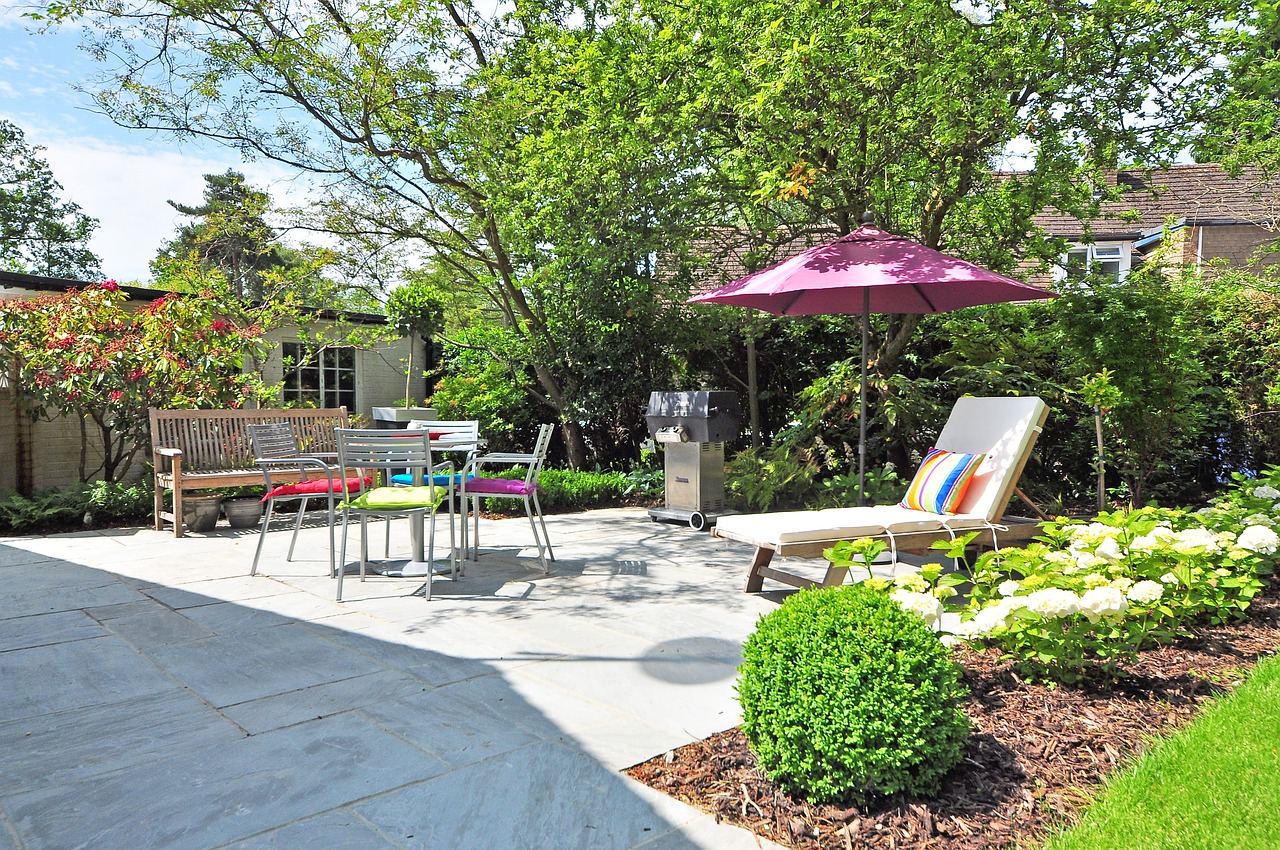
Imagine a summer evening in the yard with nowhere to sit. Seating is what turns a garden into a room. A bench under a tree, two chairs by the fire pit, or a full dining patio all count. Adding seating to your landscape design gives you a spot to read, eat or watch the kids.
Size it for what you’ll do there. A simple way to plan:
- Set out the real furniture, or chairs from inside, on the lawn.
- Leave enough room behind each dining chair to pull it out and walk past.
- Mark the outline with a garden hose and live with it for a weekend.
- Check the sun at the time you’d use it. A west-facing patio at 6 p.m. in July may need shade.
Material changes the budget. Gravel and pavers cost less than poured concrete or natural stone, and you can install them in stages. For a stone look, see our guide to landscaping with natural stone.
Sell smarter
List your home on the MLS from $99
A flat fee instead of a percentage, and $0 to Beycome at closing. You stay in control of your sale.
Sell your home →Buy smarter
Get up to 2% back at closing
On homes listed by other agents, Beycome credits you up to 2% of the price at closing (1% kept, $1,499 minimum; not on FSBO homes or homes listed by Beycome sellers).
Buy a home →
What outdoor lighting should you install?
String lights and garden lamps make a yard feel magical at night, and lights along paths and steps keep people from tripping. Family Handyman’s ideas for outdoor lighting include low-voltage systems, which it calls a good place to start for DIY beginners. They light walkways, gardens and dark corners.
Plan the light in three layers.
- Safety: steps, paths and the driveway edge.
- Feature: one or two uplights on the focal point or a tree.
- Mood: string lights or lanterns over the seating area.
Use warm-colored LED bulbs, aim fixtures down or shield them, and put them on a timer or dusk sensor. You’ll get a softer look, less glare for the neighbors and lower power use. Solar lights are fine for accents but are usually too dim for steps. Any 120-volt outdoor circuit should be done by a licensed electrician.
What do these features cost, and do they add value?
Before any digging, contact 811. The free national service has utility lines marked with paint or flags. 811 says to contact it a few business days before you start, even for planting trees and shrubs or putting in fences and mailboxes.
| Feature | DIY-friendly? | What drives the cost |
|---|---|---|
| Focal point | Often (a tree, a bench, a bowl fountain) | Water, gas or electrical lines |
| Layered planting | Yes | Plant size, soil prep, irrigation |
| Seating area | Gravel or pavers, yes; concrete, usually no | Size, base prep, material |
| Lighting | Low-voltage, yes | Number of fixtures, wiring runs, a new circuit |
Big hardscape rarely pays for itself at resale. In the 2025 Cost vs Value Report from the Journal of Light Construction, a backyard patio averaged $51,454 and recouped 46%. A wood deck addition averaged $18,263 and recouped 95%. So build the patio because you’ll use it. For curb appeal before a sale, simple, tidy planting and a few lights do more per dollar. Our posts on why outdoor design matters for value and staging your outdoor space for a sale show what buyers notice, and 10 design options that make a big difference lists more ideas.
When you sell, Beycome lists your home on the major home search sites and the MLS from $99, with $0 due to Beycome at closing, and you stay in control of every decision. Add good evening photos of the yard; buyers love them. See how a flat fee listing works.
Yard design questions
What are the most popular yard design features?
A focal point (water feature, fire pit or specimen tree), layered planting, a seating area and outdoor lighting.
How do I make my yard look lush on a budget?
Plant in layers, repeat a few native or adapted plants in groups, mulch the beds and use drip irrigation.
How much water does a yard use?
More than 30% of household water on average, and up to 60% in dry regions, according to EPA WaterSense.
Do I need to call 811 to plant a tree?
Yes. 811 says to contact it a few business days before any digging, including planting trees and shrubs or installing fences and mailboxes. It’s free.
Does a patio add value to a house?
Some, but not dollar for dollar. In the 2025 Cost vs Value Report, a backyard patio recouped 46% of its cost on average.
What kind of outdoor lighting is easiest to install?
Low-voltage kits are a good start for beginners, per Family Handyman. New 120-volt circuits need a licensed electrician.
Water figures from EPA WaterSense, dig guidance from 811 and remodeling figures from the Journal of Light Construction 2025 Cost vs Value Report (national averages), read October 29, 2026. Local rules on fire pits, lighting and permits vary. Beycome Basic is $99 as of October 2026; “$0 at closing” means no Beycome fee at closing, while other closing costs still apply. General information.
Sources
- EPA WaterSense, Statistics and Facts, read October 29, 2026.
- EPA WaterSense, What to Plant, read October 29, 2026.
- 811, Before you dig, read October 29, 2026.
- Journal of Light Construction, 2025 Cost vs Value Report, read October 29, 2026.
- Family Handyman, Backyard Lighting Looks, read October 29, 2026.
- Beycome, listing package features, October 2026.
Disclosure & Disclaimer
Beycome provides real estate services through affiliated licensed brokerages and has a commercial interest in the services and business models discussed on this blog. Content reflects Beycome’s perspective and may promote our services; it should not be treated as independent or neutral reporting.
Articles are provided for general informational and educational purposes only, not as financial, tax, legal, or investment advice or a recommendation for your particular situation. Reading this blog does not create a brokerage, advisory, or other professional relationship.
Information, opinions, pricing, service descriptions, and comparisons reflect the sources and information available when an article was published or last updated and may change. Although we aim for accuracy, we do not guarantee that all content is complete, current, or applicable to your circumstances. Laws, market conditions, and service availability vary by location. Examples and estimated savings are illustrative, depend on stated assumptions, and do not guarantee individual results.
Verify relevant information directly and consult qualified professionals before making decisions. Beycome services are subject to applicable agreements, eligibility requirements, and state-specific terms.
